Undifferentiated Marketing
Using an undifferentiated marketing strategy, a firm might decide to ignore market segment differences and go after the whole market with one offer. This can
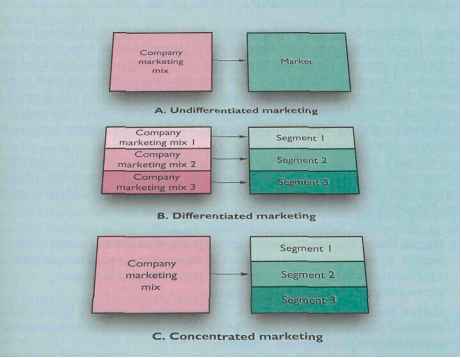
- Figure 9.5
Three alternative market-coverage strategic?
be because there are weak segment differences or through the belief that the product's appeal transcends segments. The offer will focus on what is common in the needs of consumers rather than on what is different. The company designs a product and a marketing programme that appeal to the largest number of buyers. It relies on quality, mass distribution and mass advertising to give the product a superior image in people's minds. Advertising and promotions have to avoid alienating segments, and so are often based on product features, like 'Polo, the mint with the hole', or associated with a personality of broad appeal, like Esso's tiger.
Undifferendated marketing provides cost economies. The narrow product line keeps down production, inventory and transportation costs. The undifferen-tiated advertising programme keeps down advertising costs. The absence of segment marketing research and planning lowers the costs of market research and product management.
Most modern marketers, however, have strong doubts about this strategy. Difficulties arise in developing a product or brand that will satisfy all consumers. Finns using undiffereutiated marketing typically develop an offer aimed at the largest segments in the market. When several firms do this, there is heavy competition in the largest segments and neglected customers in the smaller ones. The result is that the larger segments may be less profitable because they attract heavy competition. Recognition of this problem has led to firms addressing smaller market segments. Another problem is erosion of the mass market as competitors develop new appeals or segments. For example, Polo mints have faced attacks from competitors aiming at different benefit segments: Extra Strong mints for people who want a strong taste and Clorets as breath fresheners. At the same time, Polo faces direct competition from similarly packaged Trobor Mints in Europe and Duplex in .south-east Asia.
differentiated marketing A marker-coverage strategy in which a firm decides to target several market segments and designs separate offers for each.
eoiicentrated marketing A market-coverage strategy in which a firm goes after a large share of one or a few submarkets.
Continue reading here: Choosing a Market Coverage Strategy
Was this article helpful?
Readers' Questions
-
sanna-leen1 year ago
- Reply